
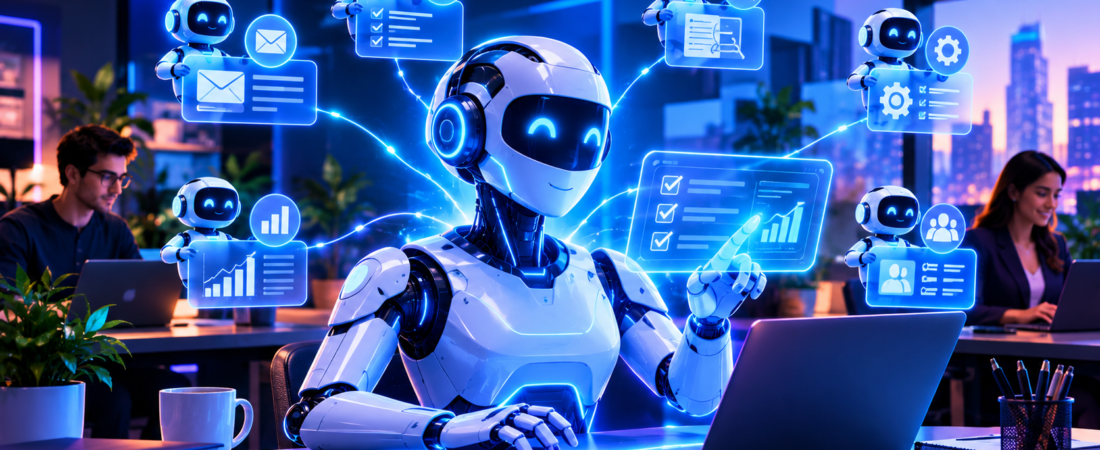
Artificial Intelligence is entering a new phase. Instead of only responding to individual prompts, a new generation of AI systems known as AI agents can plan tasks, use digital tools and complete multi-step workflows with limited human intervention.
What are AI agents?
AI agents are software systems designed to understand a goal, break it into smaller tasks and take action toward completing it. Depending on their configuration, they can search through information, organize files, draft messages, analyze data or interact with business applications.
Unlike a basic chatbot, an AI agent is built to handle a sequence of actions rather than provide only a single response.
How AI agents can improve productivity
AI agents can help professionals manage repetitive and time-consuming activities. For example, an agent may summarize documents, prepare a project brief, organize meeting notes or create a first draft of a report.
These capabilities can reduce administrative work and give employees more time to focus on strategy, creativity and communication.
Applications across different industries
Businesses can use AI agents in customer service, marketing, software development, finance and operations. A customer service agent could classify requests and suggest responses, while a development agent could help review code or document a project.
The most useful applications are usually those that combine automation with human review and clearly defined business goals.
AI agents and the future of work
As these systems become more capable, many jobs may change rather than disappear completely. Workers will increasingly need to check AI-generated results, define objectives, manage automated workflows and make decisions that require judgment.
This shift may also create demand for new skills, including AI literacy, process design, data protection and critical thinking.
Challenges and risks
Autonomous AI systems must be monitored carefully. They can produce inaccurate information, misunderstand instructions or take an inappropriate action if they have excessive access to data and applications.
Companies should use permission controls, activity logs, testing procedures and human approval for sensitive tasks. Privacy and cybersecurity should also be considered before connecting an AI agent to internal systems.
Conclusion
AI agents have the potential to transform productivity by moving from simple answers to practical task execution. Their value will depend not only on technical capabilities, but also on responsible implementation, clear limits and effective human oversight.
For businesses and professionals, learning how to work with AI agents today may become an important advantage as digital workplaces continue to evolve.