
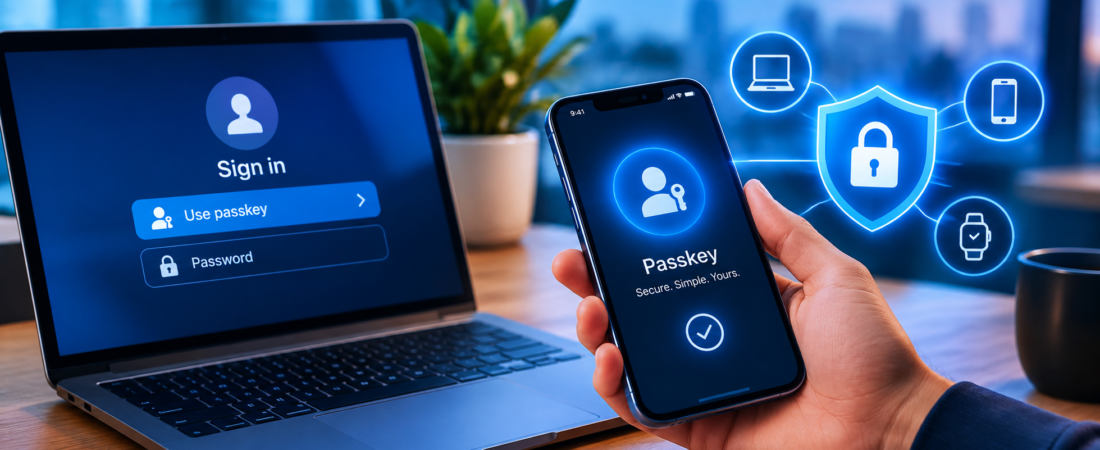
Passwords have protected online accounts for decades, but they have also become one of the weakest links in digital security. Reused credentials, phishing attacks, data breaches, and weak recovery methods continue to put personal information at risk. A newer technology called passkeys is designed to replace traditional passwords with a safer and more convenient way to sign in.
What Are Passkeys?
Passkeys use public-key cryptography rather than a password that must be typed and stored. When a user creates a passkey, their device generates a unique pair of cryptographic keys. The private key remains securely stored on the device, while the public key is registered with the online service.
To sign in, the user typically confirms their identity with a fingerprint, facial recognition, device PIN, or another local security method. The biometric information itself is not sent to the website. Instead, the device uses the private key to prove that the user is authorized to access the account.
Why Passkeys Are More Resistant to Phishing
Traditional passwords can be entered into a convincing fake website and immediately stolen. Passkeys are tied to the legitimate website or application for which they were created. This makes it much harder for a phishing page to use a passkey authentication attempt to access the real account.
Passkeys also eliminate the need to remember long combinations of letters, numbers, and symbols. Because there is no password to reuse across multiple services, a breach at one website does not automatically expose the same login credential elsewhere.
The Role of Phones and Password Managers
Smartphones, computers, and password managers can store and synchronize passkeys across a user’s trusted devices. This makes the technology more practical for people who regularly switch between a phone, tablet, and computer.
Users should still protect the devices and accounts that manage their passkeys. A strong device PIN, updated operating system, screen lock, and recovery method remain important. Passkeys reduce several common risks, but they do not eliminate the need for basic security habits.
What Businesses Need to Consider
For companies, passkeys can reduce the number of password-reset requests and improve protection against account takeover. However, successful adoption requires clear enrollment instructions, support for older authentication methods during the transition, and carefully planned account-recovery procedures.
Organizations should also consider how passkeys fit into employee onboarding, device replacement, administrator access, and compliance requirements. Security improvements work best when the technology is simple enough for people to use correctly.
The Future of Login Security
Passkeys are unlikely to replace every authentication method overnight, but they represent a major shift away from password-dependent security. As more websites, applications, operating systems, and devices support the standard, signing in may become faster and less vulnerable to common forms of fraud.
The most important change is not simply the disappearance of passwords. It is the move toward authentication that uses secure devices and cryptographic proof instead of secrets that can be copied, guessed, or exposed. For consumers and businesses alike, passkeys could become one of the most important upgrades to everyday online security.